
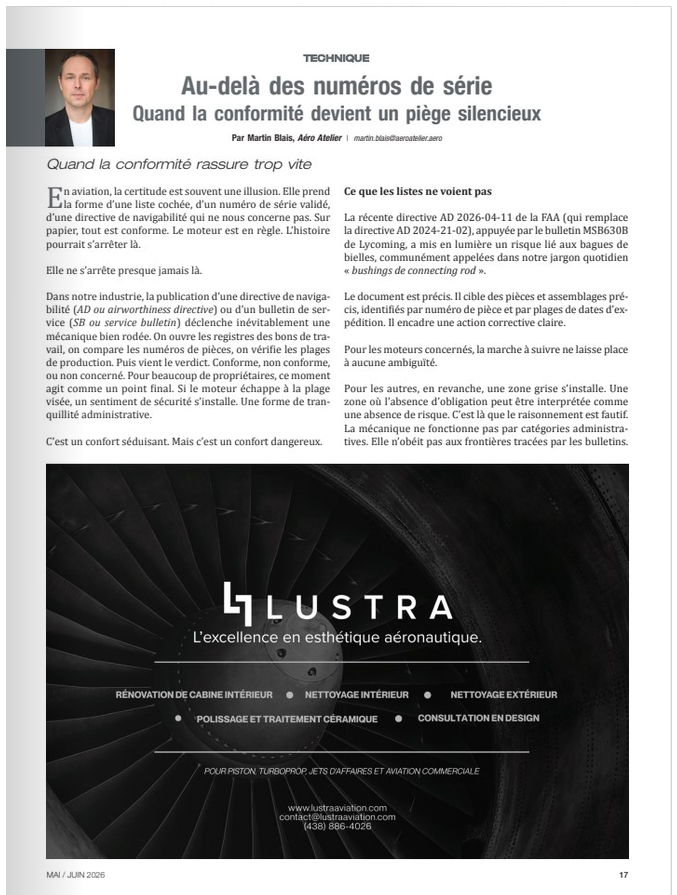
“Metal does not read service bulletins.”
To read Martin Blais’s complete article in Magazine Aviation, visit: http://magazines.smmedias.ca/V30N3/17/
The illusion of compliance
Certainty often takes the form of a checked box or a validated serial number. On paper, an engine that is not affected by a particular Airworthiness Directive may appear fully compliant. That administrative certainty is useful, but internal mechanics still obey thermal and physical laws. Parts and assemblies do not recognize the boundaries drawn by an applicability table.
A warning in the oil filter
An engine recently inspected in our shop illustrates this point. No Airworthiness Directive appeared to apply to the condition that was developing, and the engine was believed to be healthy. A routine inspection, however, revealed an unusual amount of brass in the oil filter. Rather than dismissing the finding because the engine serial number was not identified in a particular document, the owner and mechanic chose to investigate the metallic evidence.
What disassembly revealed
The investigation revealed a serious condition. Removing a cylinder exposed a fractured piston pin. The internal failure had remained invisible from the outside, and the engine had continued to operate despite the damaged component. A similar class of piston-pin concern was later addressed by the manufacturer through service documentation. The lesson is not that documentation is unimportant, but that physical evidence can reveal a problem before a particular document or applicability range does.
The discipline of doubt
Airworthiness Directives and manufacturer service information are essential tools for structuring maintenance. Relying on documents alone, however, can create a blind spot if actual inspection findings are ignored. An oil filter is a valuable source of evidence about what is happening inside an engine, and unusual metallic debris deserves appropriate evaluation under the applicable maintenance data.
Listening to the machine
Major failures are often preceded by smaller indications: an unusual vibration, a change in operating behaviour or metallic material where it should not be. The maintenance professional’s responsibility is to evaluate those indications before a condition progresses. A discrepancy that has not been explained should not simply be assumed to have disappeared.