
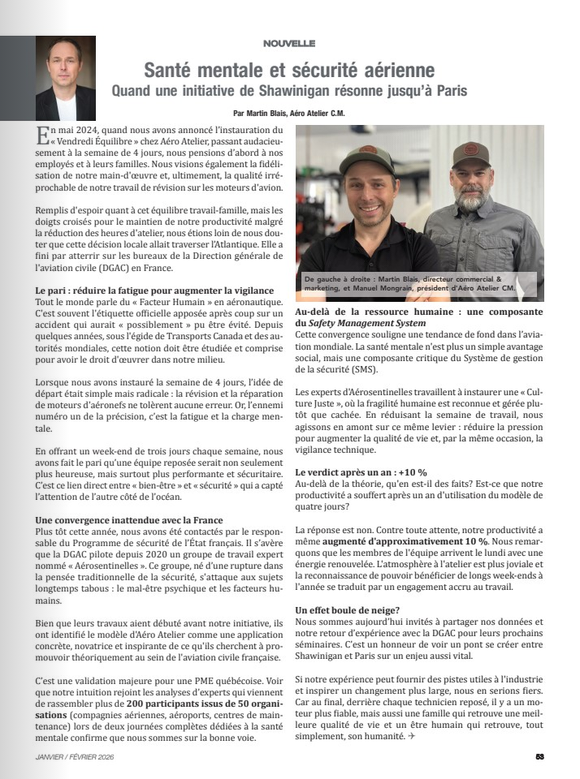
In May 2024, when we announced the introduction of “Balance Friday” at Aéro Atelier and boldly moved to a four-day workweek, our employees and their families were our first consideration. We were also aiming to improve employee retention and, ultimately, the uncompromising quality of our aircraft engine overhaul work.
To read the original article in full, visit: http://magazines.smmedias.ca/V30N1/52/
We were hopeful about this work-family balance, while keeping our fingers crossed that productivity would hold despite fewer shop hours. We had no idea that this local decision would cross the Atlantic and eventually land on the desks of France’s Directorate General for Civil Aviation (DGAC).
The bet: reduce fatigue to increase vigilance
Everyone talks about “Human Factors” in aviation. It is often the official label applied after the fact to an accident that “possibly” could have been avoided. In recent years, under the guidance of Transport Canada and aviation authorities worldwide, this concept has become something professionals in our field are expected to study and understand.
When we introduced the four-day workweek, the starting idea was simple but radical: aircraft engine overhaul and repair leave no room for error. One of precision’s greatest enemies is fatigue and mental load. By offering a three-day weekend every week, we made the bet that a well-rested team would not only be happier, but also more effective and safer. It was this direct link between well-being and safety that attracted attention on the other side of the Atlantic.
An unexpected connection with France
Earlier this year, we were contacted by the person responsible for France’s State Safety Programme. The DGAC has been leading an expert working group called “Aérosentinelles” since 2020. Born from a break with traditional ways of thinking about safety, the group addresses subjects that were long considered taboo: psychological distress and human factors.
Although their work began before our initiative, they identified Aéro Atelier’s model as a concrete, innovative and inspiring application of what they are seeking to promote within French civil aviation. That is significant validation for a Quebec SME. Seeing our intuition align with expert analysis from a group that recently brought together more than 200 participants from 50 organizations for two full days devoted to mental health confirms that we are moving in the right direction.
Beyond human resources: a Safety Management System (SMS) component
This convergence highlights a broader trend in global aviation. Mental health is no longer viewed simply as an employee benefit, but as a critical component of the Safety Management System (SMS). Aérosentinelles experts are working to establish a “Just Culture,” where human vulnerability is recognized and managed rather than hidden. By reducing the workweek, we are acting upstream on the same lever: reducing pressure to improve quality of life and, at the same time, technical vigilance.
The verdict after one year: +10% productivity
Beyond theory, what do the facts show? Did our productivity suffer after a year under the four-day model? The answer is no. Against expectations, our productivity even increased by approximately 10%. We notice that team members arrive on Monday with renewed energy. The atmosphere in the shop is more upbeat, and appreciation for having long weekends year-round translates into stronger engagement at work.
A snowball effect?
We are now being invited to share our data and experience with the DGAC for upcoming seminars. It is an honour to see a bridge form between Shawinigan and Paris around such a vital issue. If our experience can provide useful ideas to the industry and inspire broader change, we would be proud. Because in the end, behind every well-rested technician is a more reliable engine, but also a family with a better quality of life and a human being who can simply reconnect with their humanity.