Today, an aircraft component can pass through 3D CAD, finite-element analysis, CFD, digital cutting, and CNC manufacturing before the first sheet of metal is ever formed.
None of those tools existed in the 1930s. Yet EDO engineers were already developing metal floats that had to be light, rigid, watertight, aerodynamically clean, and efficient on the water.
The EDO 1320, whose original design dates to the 1930s, is a particularly good example. Fitted to aircraft such as the Piper J-3 Cub, it is a reminder that sophisticated engineering did not begin with computers. It relied on drafting, calculation, hydrodynamic testing, prototypes, tooling, and an enormous body of practical experience.
EDO: When Floats Became an Aeronautical Specialty
EDO Aircraft Corporation was founded in 1925 by Earl Dodge Osborn. The Smithsonian National Air and Space Museum preserves an extensive EDO collection and notes that the company’s first project was an all-metal flying boat called the Malolo. With a limited market for the airplane itself, EDO soon shifted its attention to all-metal seaplane floats.
That move was not a leap in the dark. A 1928 patent filing by engineer Boris V. Korvin-Kroukovsky, assigned to EDO, already shows careful work on float-bottom geometry and the reduction of hydrodynamic resistance. By 1941, according to the Smithsonian, more than 300 aircraft types from many countries had been fitted with EDO floats. The 1320 emerged from years of accumulated development rather than from a single inspired sketch.
A Float Is Much More Than a Hull That Floats
At rest, the requirement sounds simple: displace enough water to support the airplane. The moment power comes in, the engineering problem changes completely.
A float must absorb landing loads, remain watertight, stay stiff, and add as little weight as possible. In flight, it should create minimal drag. On the water, it must accelerate without feeling glued to the surface, manage spray, maintain directional stability, and tolerate changing wave conditions.
That is why the bottom geometry matters so much: the bow, chines, V-bottom, keel, beam, and aft shape all influence how the float moves through the water. A few inches or a few degrees can change how readily the airplane gets onto the surface and how much water it has to push aside.
The Step: The Small Break That Changes Everything
The step is the sharp break in the bottom of a float, roughly aft of its midpoint. At low speed, a large area of the bottom is wetted. As the airplane accelerates, hydrodynamic lift increases and the float needs to reduce that wetted area.
The step helps the water separate cleanly from the bottom. The float can then “get on the step,” moving toward a planing condition where water resistance drops enough for the airplane to keep accelerating toward takeoff speed.
Engineers of the period understood how critical that transition was. NACA’s 1930s archives contain extensive tank testing of step shapes, deadrise, spray, and resistance. In 1938, for example, NACA published hydrodynamic and aerodynamic tests of several stepped-float models intended to reduce resistance and spray without giving up the deadrise needed to absorb landing shock.
Thousands of Rivets, Entirely Analog Precision
In a profile of J.J. Frey, a former EDO vice president of seaplane operations, Aero-News described the construction of an aluminum float as requiring roughly 5,000 rivets. That number is best treated as an order of magnitude attributed to a major figure in EDO history, not as a certified rivet count for every Model 1320.
Even with that qualification, the number makes the manufacturing challenge tangible. Every panel had to be formed, drilled, fitted, and held in a jig. Hole patterns had to align. Rivets had to clamp the structure without distorting it. Joints had to remain watertight. Bulkheads, reinforcements, and skins had to stay where the drawing said they belonged.
There were no laser trackers or CNC cutters. There were drawings, fixtures, gauges, sheet-metal tools, dimensional checks, inspection, and people who knew how to produce precision with entirely analog means.
Why the EDO 1320 Works So Well With the Piper J-3
The Piper J3C-65 was approved in 1939 with the 65 hp Continental A-65-1. By modern standards that is very little power, which is exactly why the float installation is so revealing.
With 65 hp, every pound added by the float installation matters. Every bit of drag matters. On the water, poor hydrodynamic geometry immediately appears as slower acceleration and a longer takeoff run.
Aircraft Specification A-691 for the J-3 lists EDO 60-1320 floats with water rudder among the approved equipment. The specification associates the installation with 130 lb of added weight and provides, for certain J3C-65S and PA-11S configurations, a maximum seaplane weight of 1,300 lb. That gives the 1320 a well-documented place in the Cub family.
And the combination is not merely a museum story. The Transportation Safety Board of Canada documented a 1945 Piper J3C-65 still fitted with EDO 60-1320 floats in Quebec in 2021.
Anatomy of an EDO 1320
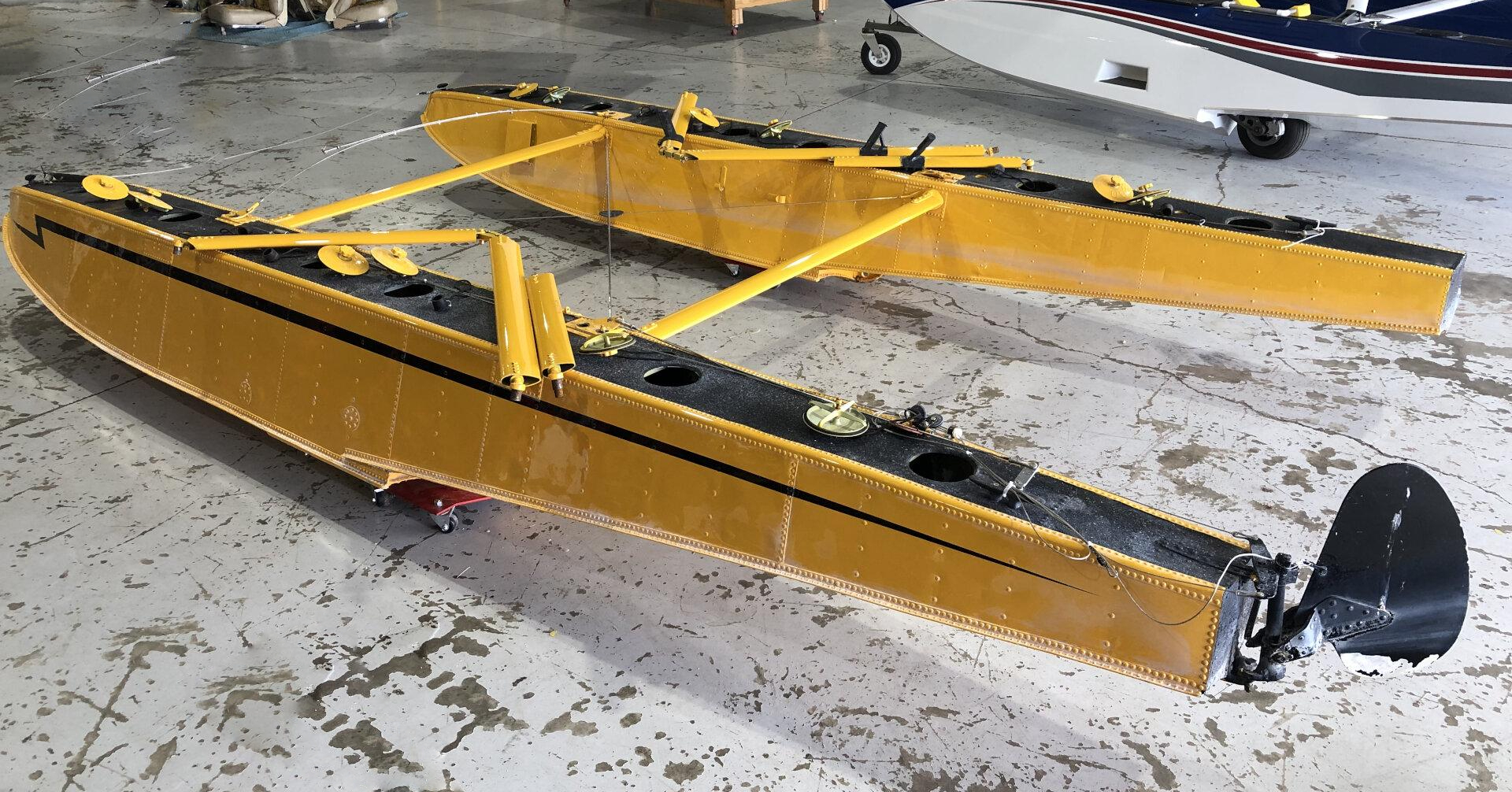
Look closely at a 1320 and its logic becomes visible. The bow parts the water; the chines define the edges between the bottom and the sides; the keel runs along the lower centerline; and the V-bottom helps manage impact loads and spray. The step separates the forward planing surface from the aft portion that rises toward the tail.
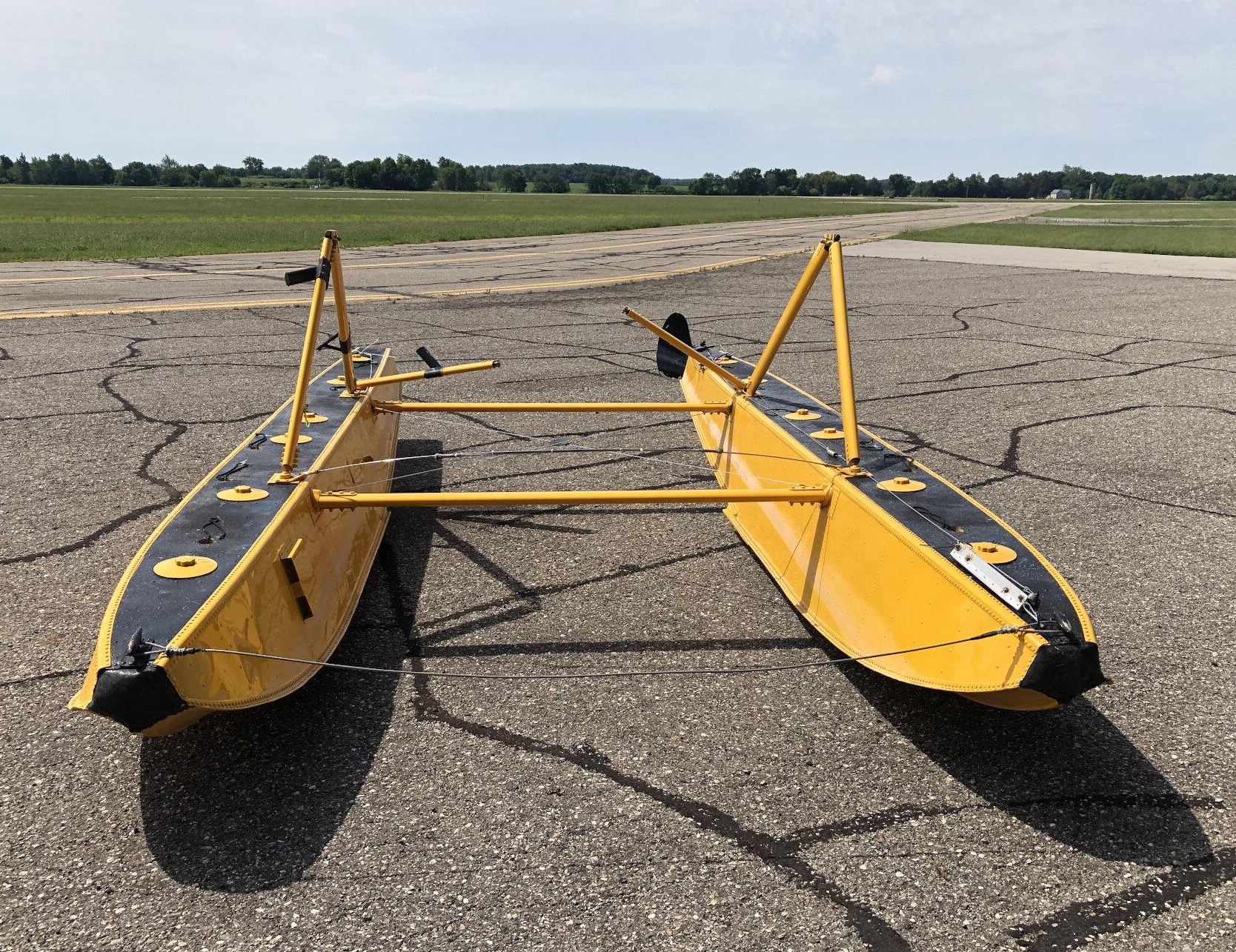
At the rear, the water rudder provides directional control at low speed. Spreader bars maintain the distance between the two floats; struts connect them to the airframe; and bracing wires stabilize the rigging. The EDO documentation still maintained by Kenmore Air shows these component families clearly: decks, skins, bulkheads, chines, keelsons, the step assembly, rudder components, and fittings.
This is not simply a pontoon. It is a compact aircraft structure designed to work in two very different fluids: water and air.
Engineering Before CAD
How did engineers arrive at a design this refined without numerical simulation?
With drafting tables, slide rules, trigonometry, large-scale drawings, hand calculations, models, and physical testing. Hydrodynamic tanks performed some of the work we now assign to CFD: engineers measured resistance, trim, spray, and planing behavior at different loads and speeds.
Then they changed the model and ran the test again.
The skill was not in “guessing right.” It was in having a method: calculate what could be calculated, measure what could not yet be predicted with enough confidence, then refine the design. The absence of computers meant a greater dependence on physical experimentation, not an absence of science.
The Design That Outlived Its Era
A 2012 article in Water Flying reports that the original 1320 drawings, dating back to the 1930s, were later redrawn in AutoCAD and brought up to contemporary specifications.
CAD did not create the 1320. Decades later, CAD became a tool for reproducing, formalizing, and modernizing the documentation for a design that already existed and had already proved itself.
Kenmore Air, which acquired EDO in 2000, still maintains an EDO documentation library that includes the Model 60-1320 parts list. A successful aircraft design is not only one that performs well on the day it leaves the factory. It also has to remain understandable, inspectable, repairable, and supportable.
When a Design Crosses Generations
The TSB record provides an unusually concrete ending to the story: a J3C-65 built in 1945 and operated in Quebec in 2021 was still carrying EDO 60-1320 floats.
That does not mean an old float is safe simply because it is old and proven. Condition, corrosion, repairs, rigging, and documentation still matter. What it does show is that an architecture born before the Second World War can remain maintainable and operational in modern aviation.
Today, a computer can evaluate thousands of hull variations and visualize water flow around a step before a prototype is built.
The designers of the EDO 1320 did not have those tools. They had calculations, pencils, tank tests, fixtures, metal, thousands of rivets, and a tremendous amount of accumulated know-how.
Decades later, their floats still exist, are still repaired, and in some cases are still flying.
It is hard to imagine a better validation of an aircraft design.